
Dis/ability
Apprehending ableism in Aotearoa New Zealand
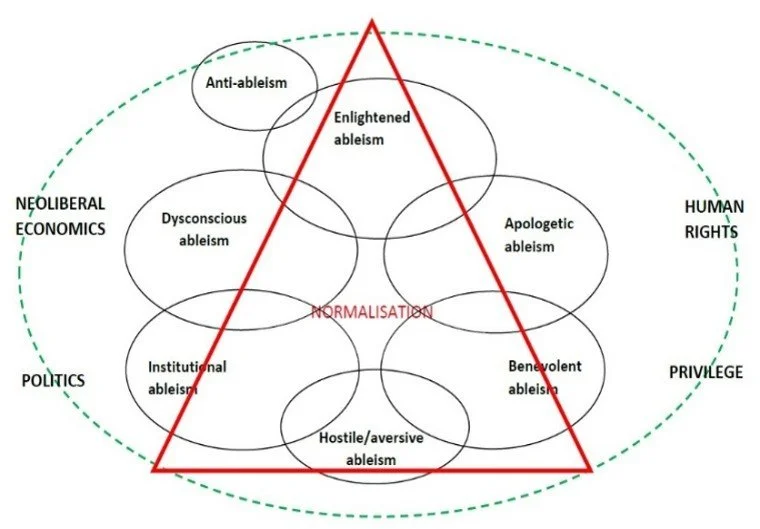
Figure 1: Variants of Ableism (diagram developed by SHORE/Whariki)
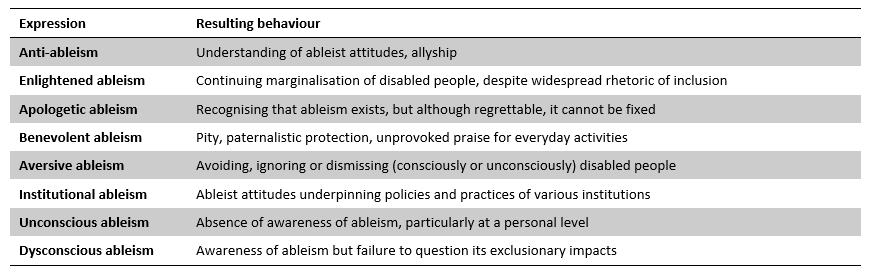
Expressions of Ableism
Ableism is expressed in various ways. Each expression is influenced by a range of external forces, including personal privilege, human rights, politics and neoliberal economics. How we express our ableism causes us to behave in different ways towards disabled people. You can see some examples in the table below.
Ableism is a form of privilege (like racism or sexism) giving able-bodied people advantages and preferred status in society because they belong to a group that is seen as ‘normal’. This disadvantages the 1 in 6 of us across Aotearoa New Zealand who are disabled. Our project, funded by the Royal Society Te Apārangi, is designed to:
• Better understand the ways individual and societal ableism are expressed
• Develop resources (for non-disabled people) to reflect on and address the negative impacts of ableism on disabled people
For the past three years our team of non-disabled and disabled researchers have explored ableist privilege and everyday attitudes and practices across the employment, health and culture/leisure sectors. Flexible quantitative and qualitative methods were employed to identify ideologies underpinning the ableist ‘normarchy’ – a system that maintains the normalisation of able-bodiedness and the ‘othering’ of disabled people.
Our research confirms that, despite widespread DEI (diversity/equity/inclusion) initiatives, ableism is maintained through unquestioned ableist attitudes. However, dialogues with our research participants highlight that personal reflection and/or sector specific trainings and exposure to disability lead to better understanding the normarchy and help us to apprehend our own ableism.
This Toby Morris comic (created for earlier research) provides a broad understanding of some of the effects of ableism on disabled people.

Tackling ableism to increase participation in Sport, PE and active recreation
Tackling ableism to increase participation in Sport, PE and active recreation.
View PDF of comic here

Enabling participation for dis/abled children and young people
Dis/abled children and young people face substantial barriers to access and inclusion, with major implications for health and wellbeing. Social interaction and recreational participation are essential for healthy development, yet the built environment and social attitudes can undermine mobility and inclusion in daily life. In collaboration with a dis/abled youth advisory group and NGOs in the dis/ability sector we have co-researched with young people with mobility, vision and hearing impairments and their parent/caregivers to understand their experiences of the public realm. In line with the New Zealand Disability Strategy definition of disability as “the process which happens when one group of people create barriers by designing a world … taking no account of the impairments of others”, we have asked: ‘how do various built, amenity and social environments constrain or facilitate access, mobility and social participation’?
This three-year multi-methods research funded by the Health Research Council (2015-2018) was carried out across Tamaki Makaurau/Auckland.
To illustrate the effects of ableism on the wellbeing of disabled young people SHORE & Whariki researchers have collaborated with cartoonist Toby Morris. Link to Toby’s cartoon here.
A recent article also explores how perceptions of differences and disabilities influence everyday interactions between non-disabled and disabled people.